Ring Spacers and Ring Blinds
Positive isolation hardware and loose rings. Spectacle blinds, paddle blinds and spacers, line blinds, and lap joint backing rings.
These are the rings that are not flanges. They go between flanges, or behind them. Some exist to block a line absolutely, some exist to fill the gap left when the blocking plate comes out, and one exists so you can rotate the bolt holes into line.
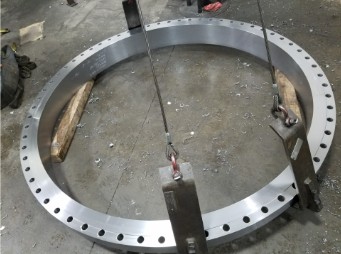
What they have in common is that they are cut and machined the same way as plate and ring flanges, which is why they come off the same shop floor at Texas Flange.
Positive isolation, and why a valve is not it
A closed valve stops flow. It does not prove the line is dead. Valves pass, valves get opened by mistake, and a handwheel position is not always a reliable indicator of what the seat is doing.
When someone is going to enter a vessel, break into a line, or do hot work near one, safety procedures want a solid plate bolted between two flanges. That is positive isolation: a physical barrier that cannot pass and whose presence can be verified by looking at it.
The hardware
Spectacle blind
Two discs on a common web, one solid and one bored through, shaped roughly like a pair of spectacles. Also called a figure eight blind.
Spread the flanges, swing the plate over, bolt up. The line is either positively blanked or fully open, the position is visible from the ground, and the plate is permanently attached to the line so it cannot be lost or fitted somewhere else.
Heavier and more expensive than paddles. Standard on lines that are isolated routinely, such as reactor and furnace connections.
Paddle blind and paddle spacer
A paddle blind is a single solid disc on a handle. A paddle spacer is a single open ring on a handle, the same thickness.
They come as a pair. The blind goes in when the line is isolated, the spacer goes in when it is in service, and the joint keeps the same face to face dimension either way.
Lighter and cheaper than a spectacle, and easier to handle on large sizes. The downside is that a loose plate can be misplaced, and a spacer can be fitted where a blind was meant to go.
Ring spacer
An open ring that fills an axial gap between flanges. Used to take up the space of a removed component, to set a required face to face dimension, or to pair with a paddle blind.
Thickness is whatever the gap requires, and it should be marked on the part so nobody has to measure it in the field.
Line blind valve
A purpose-built assembly that holds both a blank and a spacer and swaps them without unbolting the line. Some are manually operated, some geared.
Considerably more expensive than a spectacle blind, and worth it where the line is isolated often enough that breaking the joint each time is a real cost.
Thickness is a calculation
The most common error on blind and spacer orders is assuming the plate should be the same thickness as the flange, or ordering to a nominal size without stating the differential pressure.
A blind is a flat unstayed head under pressure. Its required thickness comes from the differential pressure, the diameter, the allowable stress of the material at temperature, and the design code the plant works to. It scales with diameter, so on large lines at meaningful differentials the plate gets thick quickly.
Tell us the differential, not just the class. A blind for a 36 inch line at 50 psi and a blind for the same line at 600 psi are very different parts. Give us the size, the differential pressure, the temperature, the material and the governing code, and we will calculate it and put the thickness on the drawing for approval.
The spacer is different. A spacer carries no differential, so its thickness is set by the gap it has to fill, normally matching the blind it pairs with.
Practical details that matter
- Handles and lift points. A blind for a large line is a heavy, awkward plate. Specify the handle, and on the big ones specify lifting lugs. Fitters will otherwise improvise, and that is where injuries happen.
- Marking. Size, rating, thickness, material and heat number should be stamped or marked on the handle where it stays visible with the plate installed. A blind whose rating nobody can read gets used on the wrong line.
- Extra gasket. Inserting a blind creates two joints where there was one, so you need two gaskets, and the bolt length changes. Order the studs to suit.
- Bolt length. This catches people out constantly. Adding a blind or spacer to an existing joint means the original studs are too short. Work it out before the outage, not during it.
- Face type. The blind has to suit the flange face. A raised face joint needs the blind sized for the raised face gasket, and a ring joint needs a grooved blind, which is a machined part rather than a cut plate.
Lap joint flanges and backing rings
A lap joint arrangement splits the flange into two parts. A stub end, butt welded to the pipe, provides the gasket face and the fluid contact. A loose backing ring sits behind its lap and takes the bolt load.
Two advantages follow from the ring being loose:
- It rotates. Bolt holes can be spun into alignment on assembly, which is valuable on awkward fit-ups and on equipment that has to be positioned precisely.
- It can be a cheaper material. The backing ring never touches the fluid. On an expensive alloy system, a stainless or nickel alloy stub end with a carbon steel backing ring saves substantial money, and that is often the real reason a designer chooses lap joint.
The trade-off is fatigue performance. A lap joint is not as strong in bending or cyclic service as a weld neck, so it belongs on low to moderate duty.
More in lap joint flanges and backing rings.
Orifice plates and rings
Related work off the same plate: orifice plates, the rings that carry them, and orifice flange unions with the tapped pressure connections. We supply orifice unions with or without hardware. The bore, the bevel and the plate marking all need to be on the order, because an orifice plate is a measurement device and it is machined to the flow calculation.
Common questions
What is the difference between a spectacle blind and a paddle blind?
A spectacle blind is one piece with two discs on a common web, one solid and one open, so it is always in the line and you rotate it to isolate or open. A paddle blind is a single solid disc on a handle, and a paddle spacer is a single open ring on a handle. Paddles are lighter and cheaper, and they can be left in the wrong place or lost. Spectacles cannot.
Why not just close a valve?
Because a valve is not positive isolation. It can pass, it can be opened by mistake, and its position is not always visible. For entry into a vessel, for hot work, or for any activity where a person is exposed to what is in the line, a blank plate between two flanges is the isolation that safety procedures accept. The valve stops flow, the blind proves it.
How thick does a blind need to be?
It is a pressure design calculation, driven by the differential pressure, the diameter, the material allowable stress and the temperature. It is not the same as the flange thickness and it is not a table lookup. On large diameters and high differentials the required thickness gets substantial fast, because it scales with the square of the diameter.
Do I need a spacer as well as a blind?
If you are using a paddle blind, usually yes. Inserting a blind adds its thickness plus an extra gasket to the joint, and when the blind comes out you need a spacer of matching thickness to fill the gap, or the bolts and the pipe alignment no longer work. Spectacle blinds avoid this because the solid half and the open half are the same thickness.
What is a lap joint backing ring?
A loose flange that carries no pressure. It sits behind a stub end, which is butt welded to the pipe and provides the gasket face. Because the ring is loose it can be rotated to line the bolt holes up, and it can be a cheaper material than the stub end, which is the part in contact with the fluid.
Blinds, spacers and backing rings
Give us the size, the differential pressure, the temperature and the material, and we will calculate the thickness and issue a drawing for approval.
Send the print, or send the size, class and grade. Texas Flange quotes quickly.
Request a QuoteOr call 281-484-8325 and ask for the ring flanges desk.