AWWA C207 Ring Flanges
The waterworks flange standard. Class B and D flat rings, Class E and F hubs, and how the drilling relates to the ASME templates.
AWWA C207 is the American Water Works Association standard for steel pipe flanges in waterworks service. It exists because a buried water main does not need an ASME refinery flange, and paying for one across a municipal distribution system would be absurd.
The standard defines four classes. Two are flat ring flanges with no hub, and two are hub flanges. Knowing which is which is the first step on any C207 enquiry, because people use "ring flange" loosely to mean any C207 flange.
The four classes
| Class | Style | Water working pressure | Drilling template |
|---|---|---|---|
| Class B | Flat ring, no hub | 86 psi | Class 125 template in the common sizes |
| Class D | Flat ring, no hub | 150 psi, and 175 psi in the smaller sizes | ASME B16.1 Class 125 template |
| Class E | Hub flange | 275 psi | Heavier pattern, more and larger bolts |
| Class F | Hub flange | 300 psi | Heaviest C207 pattern |
Class D is far and away the most common. It covers the bulk of municipal transmission and distribution work, plant piping and treatment facility interconnects.
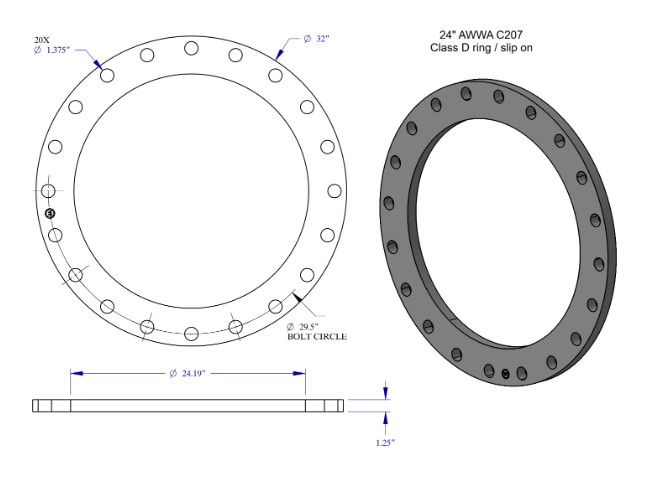
The drilling trap
AWWA C207 Class D drilling follows the ASME B16.1 Class 125 template, and that template is shared with ASME B16.5 Class 150. In many sizes, a C207 Class D ring flange will bolt straight up to a Class 150 steel flange.
That is genuinely useful when tying waterworks pipe into plant piping, and it is also responsible for a large share of the mistakes made with these parts.
Shared drilling is not shared rating. A Class D ring flange is rated for 150 psi of water. An ASME B16.5 Class 150 carbon steel flange is rated far higher, and at temperature. They bolt together and they are not equivalent parts. The joint is only as good as the weaker flange, and on a Class D ring that is well below what the bolt pattern might suggest.
There is a second issue at the same joint. A C207 ring flange has a flat face. An ASME flange in most classes has a raised face. Bolting a flat face ring to a raised face flange concentrates the load on the raised portion and puts a bending moment into the flat ring. Where that joint is unavoidable, it needs a full face gasket and it needs the engineer to have looked at it, not just the fitter.
How a ring flange is installed
A ring flange has no hub and no socket. It is a ring that slips over the pipe OD, is positioned, squared, and welded. The welds hold it and seal it, and the arrangement is set by the class and the project specification.
- Squareness matters. With no hub to locate it, a ring flange can be tacked out of square more easily than a slip-on. Out of square means the gasket does not compress evenly and the joint leaks.
- Weld sizes belong on the drawing. Do not leave fillet sizes to the fitter. The standard and the specification give them.
- Distortion from welding can pull a thin ring out of flat. On the larger and thinner sizes, welding sequence is worth planning.
- Coating and lining. Waterworks flanges are usually coated, and potable water work needs the coating specified for potable contact. Weld areas have to be recoated after fabrication.
Where C207 flanges go
Transmission and distribution mains
Large diameter welded steel water pipe, where the flange is a tie-in point for a valve, a meter or a branch rather than a routine joint.
Treatment plants
Pump connections, filter galleries, chemical feed and process interconnects, where access for maintenance justifies a bolted joint.
Pump stations and vaults
Anywhere equipment has to come out. The flange exists so a pump or valve can be pulled without cutting pipe.
Penstock and hydro
Large diameter low pressure work, often at sizes past where the ASME standards stop, and often to a drawing rather than a table.
Domestic origin on waterworks projects
More than any other flange product, C207 work carries domestic preference requirements, because so much of it is funded through State Revolving Fund programmes that impose American Iron and Steel provisions. A carbon steel ring flange is squarely an iron and steel product, so melt and all manufacturing have to be domestic, and the documentation has to prove it.
Raise that at the enquiry. See domestic and import flanges.
Past the tables
C207 covers a wide size range, but waterworks work regularly runs past it, and penstock and large intake projects almost always do. At that point the flange is a drawing: outside diameter, thickness, bolt circle, hole count and size, material. We cut flat rings from plate 1/4 inch through 8 inch thick, and machine rings through 203 inches.
Send the print, or send the five measurements off the existing flange and we will identify the pattern. See CAD and 3D drawings.
Common questions
Which AWWA C207 classes are actually ring flanges?
Class B and Class D. Both are flat rings with no hub, slipped over the pipe and welded. Class E and Class F are hub flanges, which look and behave much more like a conventional slip-on flange. People routinely say "C207 ring flange" when they mean any C207 flange, so it is worth confirming.
Can I use a C207 Class D flange on a Class 150 ASME line?
The drilling usually matches, because C207 Class D follows the ASME B16.1 Class 125 template. The rating does not. A Class D flange is rated for water working pressure well below an ASME Class 150 steel flange, and the thickness is different. Matching bolt holes is a convenience, not a substitution. The face type also needs checking, because a flat ring against a raised face concentrates load at the raised portion.
Do C207 ring flanges need welding on both sides?
Standard practice on a ring flange is a weld on the back and a weld at the face side, so the ring is held and the joint is sealed. The specific arrangement depends on the class, the pressure and the specifying engineer. The standard and the project specification govern, and the fillet sizes should be on the drawing rather than left to the fitter.
What material are AWWA C207 flanges made from?
Typically plate steel, commonly to ASTM A36 or A105 depending on the class and the specification, with stainless and other grades supplied where the water chemistry or the project calls for them. The class determines the thickness, the specification determines the grade.
What sizes does C207 cover?
The standard covers a wide range of waterworks sizes, extending well past where ASME B16.5 stops. For sizes or ratings outside the published tables, the flange becomes a drawing, and we machine to it through 203 inches.
AWWA C207 flanges, Class B through F
Tell us the class, the size and whether the project carries an origin requirement, and we will quote it with the documentation to match.
Send the print, or send the size, class and grade. Texas Flange quotes quickly.
Request a QuoteOr call 281-484-8325 and ask for the ring flanges desk.